
How to Identify Authentic Hand-Knotted Persian Rugs vs. Machine-Made Imitations
For centuries, genuine Persian rugs have stood as the ultimate symbol of luxury, craftsmanship, and cultural heritage. Each authentic piece is a unique work of art, painstakingly knotted by hand over weeks, months, or even years by master artisans. However, the modern market is flooded with machine-made imitations designed to mimic the intricate patterns of traditional Persian carpets at a fraction of the cost. Knowing how to distinguish a true hand-knotted masterpiece from a factory-produced replica protects you from overpaying and ensures you bring a genuine heirloom into your home. At Shabahang Rugs, we believe that education is the best tool for any discerning art collector.
Examining the Back: The Ultimate Tell-Tale Sign
The most definitive way to determine whether a rug is handmade or machine-made is to turn it over and inspect the back. This simple inspection reveals the internal architecture of the textile.
| Inspection Feature | Authentic Hand-Knotted Rug | Machine-Made Imitation |
| Knot Uniformity | Slightly irregular knots with visible handmade character | Perfectly uniform, machine-stitched grid pattern |
| Design Clarity | The pattern on the back mirrors the front with equal clarity | The back looks like a generic woven backing with glued or hidden threads |
| Foundation Integration | Individual warp and weft threads are visible between knots | The backing is heavily starched or synthetic with uniform synthetic stitching |
Inspecting the Fringe: Real vs. Attached
Fringe is often the easiest feature for manufacturers to fake on machine-made rugs, making it a critical point of analysis.
- Hand-Knotted Fringe: On an authentic Persian rug, the fringe is not sewn on afterward. It is the direct continuation of the vertical warp threads that run through the entire core of the rug and hold the knots in place. If you look closely where the fringe meets the rug, you will see the final row of knots.
- Machine-Made Fringe: On a power-loomed imitation, the fringe is typically manufactured separately and stitched or glued onto the finished edge of the rug as a decorative afterthought. If you gently pull on the fringe and notice it floating independently from the rug’s structural foundation, it is machine-made.
Evaluating Flexibility and Weight
Hand-knotted rugs are crafted from natural materials like hand-spun wool, cotton, and silk, giving them a supple, flexible drape. Because every single knot is tied individually around the warp threads, a genuine Persian rug is pliable enough to fold or roll easily. In contrast, machine-made rugs are woven on heavy industrial looms using stiff synthetic yarns and synthetic backings coated with heavy latex adhesives. As a result, machine-made imitations often feel rigid, stiff, and heavy, resisting natural folding and failing to drape smoothly over furniture or stairs.
Subtle Imperfections as a Mark of Authenticity
In a world dominated by mass production, perfection is usually a sign of a machine. Because authentic Persian rugs are created by human hands, they naturally exhibit slight irregularities in design symmetry, minor variations in knot density, and subtle shifts in color shading—known in the industry as abrash—caused by different dye lots. If a rug is completely flawless, perfectly symmetrical down to the millimeter, and entirely uniform in color throughout, it is almost certainly a machine-made reproduction.
Invest in True Masterpieces
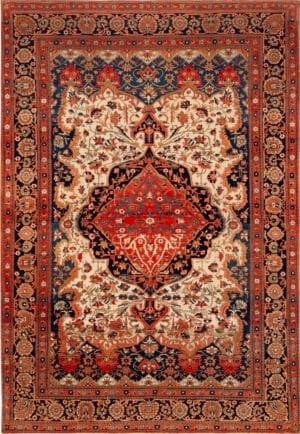
When you bring home an authentic hand-knotted Persian rug, you are acquiring a piece of living history that appreciates in beauty and value over time. Do not settle for factory-made imitations when you can experience the unmatched quality of genuine artisan craft. Contact Shabahang Rugs today to explore our exquisite collection of authentic, hand-knotted rugs or to consult our experts on finding the perfect heirloom for your space.
Frequently Asked Questions
1. Can machine-made rugs use 100% wool materials?
Yes, some higher-end machine-made rugs use wool yarn to mimic the soft feel of traditional carpets, but they are still woven on automated looms rather than tied by hand.
2. Why do machine-made rugs wear out faster than hand-knotted rugs?
Machine-made rugs rely on surface gluing and automated weaving, which fail under heavy foot traffic. Hand-knotted rugs use individual foundation knots that lock fibers securely in place, lasting for generations.
3. Do authentic Persian rugs always come with a certificate of authenticity?
Reputable dealers provide documentation of origin, material, and age, but true authenticity is best verified by inspecting the knot structure on the back and the warp fringe integration.
4. How does the price reflect whether a rug is handmade?
Hand-knotted Persian rugs require hundreds of hours of skilled labor, making them significant investments. If a complex, room-sized Persian-style rug is priced exceptionally low, it is undoubtedly machine-made.